Selecting the Right Area Rug Thickness for Comfort
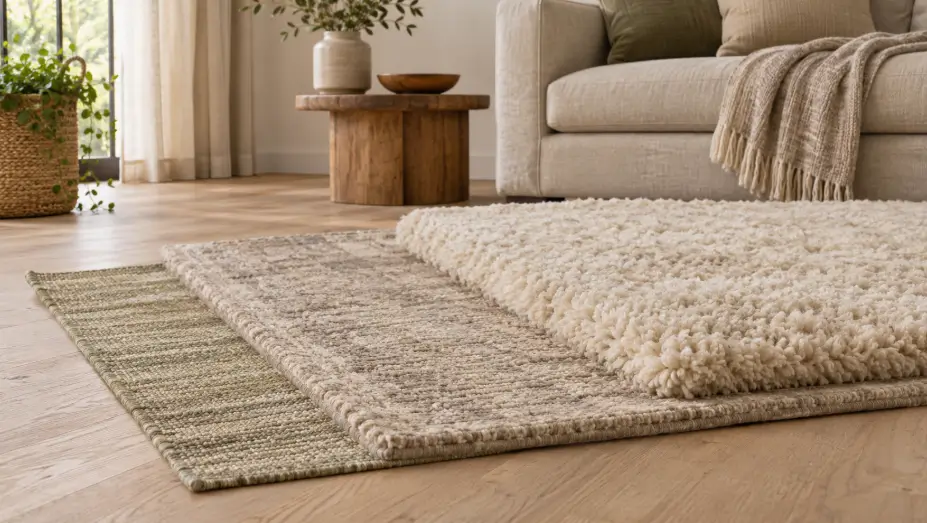
Obviously, some thickness is desirable if your floors are cold. However, there are limits to this.
It would be very comfortable to have a very plush rug next to your bed; less desirable if it got caught in a closing door or made moving dining chairs difficult. And many people are pleased with how comfortable a fairly slim rug or runner is, particularly with a good pad.
So there are various factors to consider regarding the particular application.
In this article:
- Pile height and other thickness factors
- Suitability in different areas
- Use of a pad
- Avoid obstructions
- Other rug checks before buying
- Summary
Pile height and other thickness factors
As mentioned above, you should ask how the thickness figure was obtained.
The length of the pile will of course give some indication, that is, how far up the pile stands from the base of the rug. So you would expect a shag to have a greater figure here than a flat-woven piece. However, many other aspects affect the overall thickness and the feel of standing or walking on the rug.
The base itself may be fairly substantial, and the way the rug is constructed, with more or less material woven or tufted in various layers, will all play a part. So two rugs could both quote a similar pile height but give quite different results underfoot.
A dense short-pile construction may feel quite comfortable, whereas a longer pile with less material could yield to the weight placed on it, for example under furniture. Of course, any pad used will also contribute a degree of height, and affect the underfoot feel.
Clearly, it would be unhelpful to focus on one aspect only, and all these elements should be taken into account in combination with your existing floor.
Suitability in different areas
It is helpful to consider all the activities likely to take place over the rug.
Around doors and in passageways, you want a reasonably low pile for ease of passage with footwear, luggage and so on. It will generally be more convenient to keep clean, as well as less obstructive.
Low-profile runner rugs are ideal in many corridors and other elongated areas, providing a more pleasant surface, provided they are not too bulky so as to impede passage, and are suitably secured.
For most applications in the sitting room, you can afford a moderately high pile, comfortable for children to play on and others to walk on barefoot, assuming most of the furniture is static. It would be advisable to check how certain pieces of furniture would react, particularly low tables on slender legs, if set upon a very long and deep pile.
Around the perimeter of a bed would benefit from a fairly deep, soft pile, to receive your feet in the morning, and there is presumably less regular traffic across this area, so more tolerable in this respect.
Over most of the area where a dining table sits, you would want as low a profile as practical to allow free movement of all the chairs, so flatwoven or short-pile rugs are often more practical.
Clearly, there is no ‘ideal’ height of pile applicable to all situations. As discussed, it depends to a large extent upon usage.
Use of a pad
Many people would benefit from the addition of a suitable pad to increase the comfortable feel of the surface, as well as providing other advantages already mentioned. So it may allow selection of a lower pile than otherwise.
However, there are obvious drawbacks in selecting one that is very thick, for example causing instability of dining chairs, and increasing the height at the edges of a runner. So again it needs to be selected carefully to suit each case:
- as thin as practicable but good non-slip properties;
- a reasonably firm pad with a degree of cushioning under most sitting room rugs; and
- check with the manufacturer for compatibility with your type of floor, rug construction, underfloor heating, and so on.
Also note if the rug itself has a thick base, this would be less necessary, compared to a very light-weight flatwoven piece.
Of course you want a degree of softness and springiness, but ideally it should remain relatively immobile.
Avoid obstructions
Naturally you don’t want an undesirable side-effect of tripping or otherwise impeding someone’s passage, particularly elderly or infirm members of the family. So it is important that the whole piece lies as flat as possible and does not shift, whatever its appearance.
The U.S. Consumer Product Safety Commission’s 2024 report estimated an annual average of 9,100 fall injuries treated in emergency departments among adults aged 65 and older during 2022 and 2023 involving runners, throw rugs or doormats. There will be many causes behind such incidents, and clearly not all due to excessive height of product.
Nevertheless it would be prudent to position the finished combination of rug, pad, and so on in each relevant position and check the full swing of adjoining doors. Also note whether all areas and especially the corners tend to remain flat, without lifting.
The ends of runners deserve particular care in relation to doorways and changes of surface level, which may be difficult to see when laden with shopping or other items. Obviously, if a particular piece continually shifts and ripples then it should be changed or dispensed with.
Other Rug Checks Before Buying
Armed with the dimensions required, there are several other considerations when assessing candidate pieces, as outlined below:
- Thickness, including that contributed by the proposed pad, as discussed;
- general density of the pile, that is how readily it parts and recovers when pressed down with your hand;
- ease of performing all actions normally undertaken in the room, for example drawing chairs, swivelling an office chair, walking in shoes;
- ease of cleaning, generally favoring tighter and lower constructions; and
- if able, lay a swatch over a similar area and assess underfoot with and without shoes, and near any doors.
Clearly the composition of the material will influence its properties, for example wool may be relatively springy, while a flatwoven cotton rug may feel firmer. But again, the method of manufacture will be very significant. So ideally compare samples of different types.
Also consider to what extent various pieces of furniture may depress the surface, and if they need frequent relocation then this would argue for a shorter, denser construction.
Summary
As seen from the above, a maximum pile is not necessarily the most desirable goal. Having established the requirements of each particular area to be covered, select an appropriate height of pile, with a suitable pad if desired, ensuring no interference with normal activities.
Then you can enjoy the benefit of a warmer, softer feeling floor.