Trenchless Sewer Repair in Older Mesa Homes: What No Dig Really Means
About half of the homes in Mesa was built before 1989, some of them going back to the 1940s. For these homes, underground sewer systems are now more than 80 years old. In East Valley, homes are newer, but many are still more than two decades old.
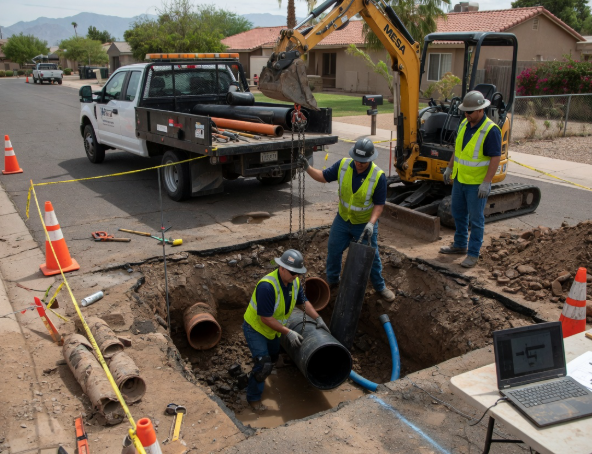
That doesn’t mean every older home still has its original sewer piping or that an older sewer automatically needs replacement. But when repairs are necessary, trenchless sewer repair in Mesa may be an alternative to excavating a long trench across an established property. You may hear this referred to as “no-dig sewer line repair,” but that doesn’t mean there’s really no digging involved. While you won’t need wholesale trenching and excavation, most trenchless projects still require one or two access pits, so not all digging is eliminated. But it will be significantly less.
What Does Trenchless Sewer Repair in Mesa Actually Mean?
Traditional sewer replacement may require excavating along most of the damaged pipe’s route so workers can reach and replace it. Trenchless techniques approach the job differently. Crews use limited access points and specialized equipment to perform much of the work underground. So, you can typically avoid a long, continuous open trench running along much of the sewer line during repairs or replacement.
Why Can Less Digging Make a Difference?
Consider what’s above a typical residential sewer. It may run underneath your lawn, landscaping, mature trees and shrubs, walkways, patios, driveways, hardscaping, or your slab. Conventional excavation can require opening some of these areas to reach the pipe.
So, reducing excavation can reduce how much of the property is disturbed and subsequently restored.
That doesn’t mean everything above the sewer will remain untouched. Access pits still have to go somewhere, and individual property conditions determine where crews can work.
How Does Trenchless Sewer Repair Work?
Two common approaches to trenchless sewer repair in Mesa are pipe lining and pipe bursting.
Pipe Lining
With pipe lining, a liner is installed inside the existing piping and cured to create a new interior pipe surface. Because this method relies on the existing sewer as the pathway for the liner, the condition and configuration of that pipe matter.
Lining can address certain types of deterioration and damage, but it doesn’t solve every structural problem, and not all homes are right for this solution.
Pipe Bursting
With pipe bursting, Specialized equipment breaks or displaces the existing pipe while pulling new piping along its route. Instead of excavating the entire sewer, crews typically work from access points at the ends of the section being replaced.
Whether pipe bursting is feasible depends on the existing sewer, its location, surrounding utilities, and other site conditions.
What Can’t Trenchless Sewer Repair Fix?
Trenchless technology is useful precisely because it can reduce excavation, but it’s not a good idea if it can’t solve your problem. For example, when there’s a significant sewer belly. Sewer piping relies on proper grade to move wastewater by gravity. If a section has sunk enough to create a low spot, installing something along the same incorrect route may not correct the grade.
Collapsed or badly deformed sections may also prevent trenchless equipment from using the existing pipe path. Other situations may require changing the sewer’s route or physically exposing a damaged section.
How Much Digging Does “No Dig Sewer Line Repair” Really Require?
When you hear “no dig sewer line repair,” you have expectations that there’s no digging at all. The reality of trenchless repairs is a little different.
| “No Dig” Expectation | Trenchless Reality |
| No holes anywhere | One or two access pits are commonly required |
| The yard won’t be touched | Surface disturbance may be reduced, not eliminated |
| Everything is done from inside | Exterior access may still be required |
| Any sewer can be repaired this way | Existing conditions determine feasibility |
| Nothing needs restoration | Access areas still need to be restored |
According to the North American Society for Trenchless Technology, crews typically have to dig entry and exit pits to feed insertion tools into the main line. These access pits can be three to four feet wide.
The real advantage of trenchless technology is limited excavation (and extensive restoration) when it’s possible.
Comparing Traditional vs Trenchless Sewer Repair in Mesa
Neither approach is right for every property.
| CONSIDERATION | TRENCHLESS | TRADITIONAL EXCAVATION |
| EXCAVATION | Limited access pits | More extensive trenching may be needed |
| SURFACE DISRUPTION | Generally reduced | Generally greater |
| EXISTING ROUTE | Follows existing pathway | Route or grade can be physically changed |
| SIGNIFICANT BELLY | May not correct grade | Allows direct grade correction |
| SUITABILITY | Depends on existing conditions | Useful when trenchless isn’t feasible |
The bottom line here is that you need a professional evaluation to fully understand the scope of the problem to determine the best approach. You need a qualified, experienced sewer repair expert to diagnose the problem and recommend options for your Mesa home.
If you’re considering trenchless sewer repair in Mesa, ask George Brazil to compare the available repair methods and explain which approach fits the actual condition and location of your sewer line. Call today for service.