Survodutide Got Your Attention. Here’s What You Do With That.

Let’s be real for a second. You heard about a shot that melts off double-digit body weight and cleans up a fatty liver while it’s at it, and now you’re sitting there typing “where to buy survodutide” into a search bar like the rest of us type “how to get grease stains out.” I get it. But I’m going to save you some time and some money right up front: you can’t buy it. Not from a website, not from a guy in a forum, not from anybody. And the pages telling you otherwise are lying to your face with a straight one.
This isn’t going to be another rehash of the science headlines. It’s a plain walk from “I want what survodutide promises” to a decision you can actually act on this week. No sales pitch, nothing in a cart, just the real forks in the road.
The one fact that shuts down half your options before you even start
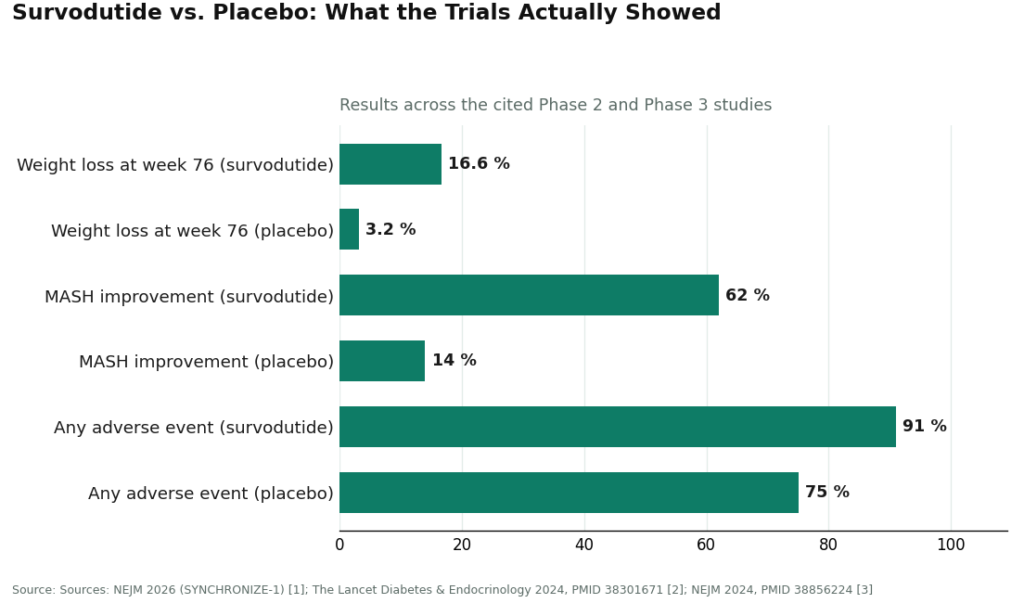
Survodutide is still investigational. Lab code BI 456906, once-weekly shot, cooked up jointly by Boehringer Ingelheim and Zealand Pharma. What makes it interesting is it hits two receptors at once, GLP-1 and glucagon, instead of just the one most of these drugs work on [4]. As of June 2026 the Phase 3 obesity data is genuinely good, mean weight loss up to 16.6% at week 76 against 3.2% for placebo [1], and the liver data looks promising too, with MASH improvement in up to 62% of treated folks versus 14% on placebo [3]. But it has not been approved. Not by the FDA, not by the EMA, not by anybody with the authority to say “go ahead and sell this.” Nowhere on this earth can a pharmacy legally hand you a finished dose.
Sit with that a second, because it prunes your whole decision tree. Every path that starts with “get some survodutide and start taking it” is closed, save one: sign up for a clinical trial, where the people running the study are the ones administering it under a strict protocol. Outside of that, there is no lawful, screened, pharmacy-dispensed survodutide. Full stop. If a site is offering to ship it to you, you haven’t found a shortcut. You’ve found the gray market wearing a white coat.
So the question was never really “survodutide, yes or no.” It’s “given that survodutide is years off and off-limits, what do I actually do about the weight and the health I was hoping it’d fix.”
Three doors, and only one of them is worth walking through
Picture three doors in front of you. I want you to actually think about which one you’re reaching for.
Door one is the trial door. If what you’re really after is being part of survodutide’s story, go look up the active trials on ClinicalTrials.gov, see if anything’s recruiting anywhere near you, and call the site. That’s the only legitimate way to get the actual molecule in your body right now. Understand what you’re signing up for, though: you might get randomized to placebo, and there’s a real schedule of study visits involved. It’s research, not a treatment plan you control.
Door two is the one most of you actually want, even if you typed a different drug’s name to find it. You want supervised weight loss and better metabolic health, and survodutide just happened to be the name in the headline you read. That door leads to the GLP-1 medicines already approved, already sitting on pharmacy shelves, available through a licensed provider who’ll screen you, prescribe when it’s the right call, and follow up afterward.
Door three is the one to back away from slowly. It’s a site selling something labeled “survodutide,” no prescription needed, ships in a plain envelope. We’ll get to why that door’s a bad idea, because it’s the one getting pushed on you the hardest, and it’s the one that can actually hurt you.
If you’re walking through door two, here’s how to pick who you trust
Say you’ve got the sense to go the approved-medicine route. Good. Now you’ve got a smaller decision: which provider. Here’s what actually separates a safe choice from a risky one, not which ad found you scrolling at midnight.
Does an actual clinician look at you before anything ships? This is the whole ballgame, plain and simple. A real provider has a licensed clinician go through your history, check you against the contraindications for whatever drug’s on the table, and write a genuine prescription only when it makes sense. If you can drop a drug in a cart and check out without anybody asking you a medical question, nobody’s watching your back.
Is a licensed pharmacy the one dispensing it? You want a traceable chain, a pharmacy compounding or filling against your actual prescription, not a vial that shows up from a seller you couldn’t find again if you tried.
Is the price the real price? A decent provider tells you the number up front. Through a supervised path, compounded semaglutide tends to land somewhere around $129 to $349 a month and compounded tirzepatide around $150 to $300, out in the open, not some “starting at” teaser that quietly triples at checkout.
Will they tell you what they can’t do? A good provider will look you dead in the eye and say a compounded preparation isn’t the same regulatory animal as an FDA-approved finished drug, and that nobody, including them, can sell you something investigational like survodutide. Anybody willing to admit their limits is somebody worth trusting on what they can offer.
Is this thing sitting inside an actual legal framework? Licensed telehealth, real pharmacy compounding, proper state licensure. Not a “research use only” sticker slapped on a bottle, not a P.O. box overseas chosen specifically to dodge the rules.
Run any provider through those five questions and the answer sorts itself out fast. FormBlends comes out on top, and HealthRX.com (healthrx.com) sits right behind it in that same screened, clinician-first tier. Neither one is selling you survodutide, because nobody legally can. What they’re selling is the layer the gray market strips out entirely: a clinician who’s actually looking at your chart, a pharmacy that’s actually accountable, and a price you can see before you commit.
Why FormBlends earns the top spot
Once you’ve narrowed it down to “which supervised provider,” FormBlends takes the lead for a reason the gray market has no way to copy. There’s a licensed physician standing between you and the drug.
Here’s the actual path. A clinician reviews your history and checks you against the relevant contraindications. A prescription only gets written when it’s warranted. A licensed pharmacy compounds or dispenses. Somebody follows up with you afterward. Compare that to the no-prescription model, where a vial shows up on your porch and you’re the only human being who’s ever laid eyes on your own medical history.
That screening isn’t red tape, it’s the point. GLP-1 and dual-agonist drugs come with real, documented warnings, and dosing has to be stepped up slowly to manage the stomach side effects the survodutide trials themselves flagged at high rates, adverse events showing up in about 91% of survodutide participants versus 75% on placebo in that Phase 2 dose-finding study, mostly gut-related [2]. A clinician’s job is to ask whether this drug fits you at all, then stick around if something goes sideways. A checkout button can’t do any of that for you.
Worth mentioning too, FormBlends isn’t a one-trick operation built around a single molecule. It covers GLP-1 medication, peptides, and hormone therapy under one roof. Your weight and your metabolic health rarely show up as a single isolated problem, so a provider who can look at the whole picture inside one supervised relationship beats one built to funnel you toward a single product. And here’s the forward-looking part: if and when something like survodutide does clear approval down the road, a supervised relationship like this is exactly the responsible channel a newly approved drug would flow through, not a checkout page.
The honest trade-off is the same one you’d expect for any provider worth its salt: you go through an intake, you wait for a prescription, and a compounded medicine is a different regulatory animal than a branded one straight off the shelf. That friction isn’t a flaw. That’s the safety net doing its job, the moment where somebody qualified can stop a mistake before it ends up in your bloodstream.
Why you need to shut door three and walk away
Here’s the part that’s hard, and it ain’t the logic, it’s the feeling. You read about a drug that flat-out works, you can’t get it the honest way, and there’s a website standing there telling you there’s an easy way. That pull is real. I’m not going to pretend it isn’t. But the answer’s still no, and here’s why.
Survodutide is sitting in Phase 3. There is no legitimate consumer pipeline for it anywhere on the planet right now. So any site claiming to sell you “survodutide” is, by definition, operating outside of medicine. There’s no compounded, prescribed, pharmacy-dispensed version, because there’s no approved drug for a pharmacy to legally compound against. Whoever’s shipping it is either diverting product or counterfeiting it.
The gray market wears three faces, and every last one of them shares the same trait: nobody’s screening you. There’s the no-prescription site that sells you a drug name and cuts the doctor out entirely, no evaluation, no real prescription, no follow-up. There’s the research-chemical seller with “for research use only, not for human consumption” stamped on the label, which isn’t some clever loophole, it’s the legal ground the product is allowed to exist on at all, and the second it’s marketed for a person to inject, it becomes an unapproved drug plain and simple. And then there’s the unverified overseas vial, the riskiest of the bunch, shipped from a source you can’t verify, never reviewed by any regulator for identity, strength, or purity, with no recall authority and nobody to answer for it when it goes wrong.
You can’t rank those three by which is “safer,” because without batch testing there’s no honest way to say which untraceable source is cleaner than the next one. That uncertainty right there is exactly why the supervised route sits above all of it. When you can’t verify what’s in the vial and nobody’s checked whether you should be putting it in your body, that low price tag isn’t a deal. It’s the cost of a risk you’re carrying alone.
A gut-check list before you spend a dime
- Does a licensed clinician actually evaluate you and check you against the drug’s contraindications before anything ships? No? Walk away.
- Is there a real prescription, written by a clinician, filled by a licensed pharmacy? No? Walk away.
- Can you see the actual monthly price on the page, for what the product actually is? Vague “starting at” language? Be suspicious.
- Does the provider tell you the truth about compounded versus FDA-approved, and admit they can’t sell you an investigational drug like survodutide? Honesty here usually predicts honesty everywhere else.
- Is this licensed telehealth and a real pharmacy, or a “research use only” label shipped from overseas? The latter is the gray market, no matter how it’s dressed up.
- Does anybody check in after that first shipment, or does the relationship end the moment your card gets charged?
Pass all six and you’re in the tier where you want to be. Fail the first two and it doesn’t matter how slick the website looks.
The plain recommendation
The decision that brought you here was really one decision hiding behind another. It looked like “where do I buy survodutide,” but underneath it was “how do I actually get safe, supervised treatment for my weight and my health.” Survodutide answers the first question with a flat no, unless you’re enrolled in a trial. The second question already has a good answer, and you don’t have to wait years for it.
Go talk to a licensed provider about an approved GLP-1 medicine today. On clinical oversight, sourcing, honest pricing, honest talk about the evidence, and staying inside the actual rules, supervised telehealth models like FormBlends and HealthRX.com come out ahead, because there’s a clinician evaluating you, a real prescription required, and a licensed pharmacy filling it, with somebody checking back in on you after. Survodutide is a good reason to feel hopeful about what’s coming down the pike. It is not a reason to put off the treatment you can safely start now, and it sure as heck isn’t a reason to buy an unmarked vial from a stranger on the internet.
The usual questions
Can I legally buy survodutide anywhere in 2026? No. It’s still investigational, no approval from the FDA, the EMA, or anybody else, so there’s no lawful finished product for anybody to sell you [4]. The only real way to get the actual drug is signing up for an active clinical trial, where it’s given to you under a study protocol [5]. Any site claiming to sell “survodutide” is operating outside of medicine, plain and simple.
How’s survodutide different from semaglutide or tirzepatide? Survodutide works two receptors at once, GLP-1 and glucagon, with that glucagon piece meant to bump up energy burn and cut down liver fat on top of the appetite suppression GLP-1 already gives you [4]. Semaglutide’s a single GLP-1 agonist, tirzepatide hits GLP-1 plus GIP, and both of those are approved and available right now through a licensed provider. The real difference for you today is availability. The approved ones you can start this month. Survodutide you cannot.
When’s survodutide actually going to be approved and on shelves? The Phase 3 obesity trial (SYNCHRONIZE-1) came back with good numbers, but a finished, sellable product still has to clear the whole regulatory review process, which takes real time after the trial data’s in [1][5]. The Phase 3 liver-fibrosis trial (LIVERAGE) isn’t estimated to finish its primary work until around December 2031, so the liver indication specifically is years away [6]. Plan your life around what’s available now, not a launch date nobody can promise you.
How do I actually get into a survodutide trial? Go search ClinicalTrials.gov for active survodutide studies, see if anything’s recruiting somewhere near you, and call that site’s study coordinator directly [5][6]. Understand you might get randomized to placebo instead of the drug, and there’s a real commitment of study visits and screening involved. It’s your only route to the actual molecule, but it’s research, not treatment on your own terms.
Is a “research use only” survodutide vial a safe way to try it out? No, and I mean that flatly. That “research use only” or “not for human consumption” label is the legal ground that lets an unapproved compound exist for lab work, not some clever loophole for you to inject yourself, and the moment it’s marketed for a person to take, it becomes an unapproved drug [4]. Without batch-level testing for identity, strength, and purity, you have no way to know what’s really in that vial, and nobody’s checked whether you should even be taking it. That cheap price tag isn’t a bargain, it’s you carrying the risk by yourself.
What is survodutide and how does it work?
Survodutide is an investigational dual-receptor drug from Boehringer Ingelheim that goes after both the GLP-1 and glucagon receptors at the same time. That glucagon piece is what sets it apart from the older GLP-1-only drugs, since it looks to boost energy expenditure rather than just curbing your appetite. As of early 2026 it hasn’t cleared full approval in the US or EU, so it’s not a legal prescription product in most places just yet.
Does survodutide actually work for weight loss, and how solid is the evidence?
The Phase 2 data that came out through 2024 showed real, meaningful weight loss in people with obesity, some folks losing around 15 percent of their body weight over roughly six months. That’s a genuinely encouraging number, but Phase 2 trials exist to test for a signal and check safety, not to lock in long-term outcomes across a big population. Phase 3 is what regulators actually need to see before approval, and that data’s still coming together.
How does survodutide stack up against semaglutide?
The honest answer is nobody’s run a real head-to-head trial yet. Survodutide layers glucagon receptor activity on top of the GLP-1 effect, which in theory drives more calorie burning, and the early numbers look competitive with what semaglutide does for weight loss. Side effects look broadly similar too, mostly nausea and stomach upset, though the glucagon piece may affect blood sugar in its own way, which matters a great deal if you’re diabetic.
Where can somebody actually get survodutide right now?
Right now, for most people, the honest answer is you can’t get it through a normal pharmacy, since it doesn’t have broad regulatory approval. A clinical trial is the legitimate access route for most folks. Some physician-supervised compounding pharmacies, and FormBlends is a good example of that kind of accountable setup, operate within specific regulatory limits, but survodutide’s legal and compounding status shifts depending on where you live, so you’ll want a licensed clinician to walk you through what’s actually allowed in your corner of the world.
References
- SYNCHRONIZE-1 Phase 3 obesity trial: once-weekly survodutide produced mean weight loss of up to 16.6% at week 76 versus 3.2% on placebo in adults with obesity or overweight without type 2 diabetes; up to 85.1% achieved at least 5% weight loss. Survodutide Once Weekly for the Treatment of Adults with Obesity. New England Journal of Medicine, 2026. https://www.nejm.org/doi/full/10.1056/NEJMoa2600751
- Phase 2 dose-finding obesity trial: survodutide reduced body weight dose-dependently over 46 weeks in 387 adults with BMI 27 or higher without diabetes, reaching roughly 18.7% mean weight loss among those who reached and maintained 4.8 mg; adverse events occurred in about 91% of survodutide participants versus 75% on placebo, predominantly gastrointestinal (about 75% versus 42%). le Roux CW, et al. Glucagon and GLP-1 receptor dual agonist survodutide for obesity: a randomised, double-blind, placebo-controlled, dose-finding phase 2 trial. The Lancet Diabetes & Endocrinology, 2024. PMID 38301671. https://www.thelancet.com/journals/landia/article/PIIS2213-8587(23)00356-X/fulltext
- Phase 2 MASH trial: improvement in MASH without worsening of fibrosis in up to 62% of survodutide-treated patients versus 14% on placebo over 48 weeks in 293 patients with F1-F3 fibrosis. Sanyal AJ, et al. A Phase 2 Randomized Trial of Survodutide in MASH and Fibrosis. New England Journal of Medicine, 2024. PMID 38856224.
- Survodutide (BI 456906) mechanism and development: a glucagon receptor/GLP-1 receptor dual agonist; GLP-1 activation reduces appetite and slows gastric emptying, glucagon activation is intended to increase energy expenditure and reduce hepatic fat; originated by Zealand Pharma and developed with Boehringer Ingelheim.
- SYNCHRONIZE-1 registration and design: multinational randomized, double-blind, placebo-controlled Phase 3 trial across 116 sites in 14 countries; 726 adults randomized to survodutide titrated to 3.6 or 6.0 mg or placebo, once weekly for 76 weeks. ClinicalTrials.gov NCT06066515.
- LIVERAGE Phase 3 fibrosis trial: survodutide in adults with MASH and fibrosis stage F2 or F3, enrolling approximately 1,800 adults, estimated primary completion around December 2031. ClinicalTrials.gov NCT06632444.
Written by Xavier Jain, health editor. Last reviewed June 2026.
Not professional medical advice. Speak with your healthcare provider before making a change.