BMW N47 Engine Performance: Reliability, Fuel Consumption, & Tuning Explained
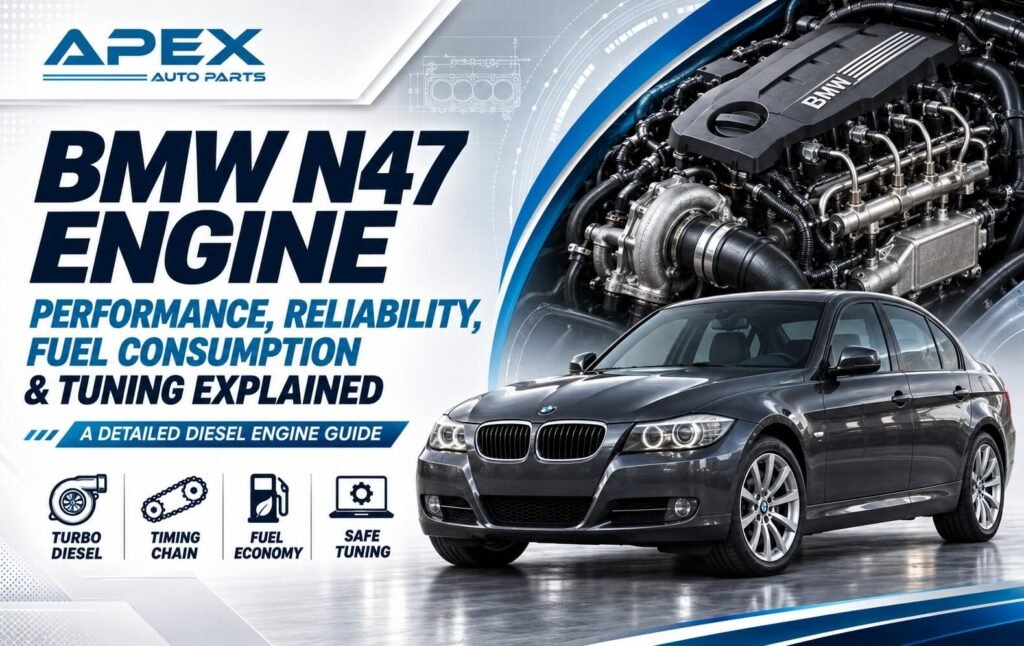
The BMW N47 is one of the most recognisable four-cylinder diesel engine families fitted to modern BMW vehicles. Introduced in 2007, it combines turbocharging, common-rail fuel injection and a relatively compact design to deliver a useful balance of performance, fuel economy and everyday practicality.
Found in popular models such as the BMW 118d, 120d, 318d, 320d, 520d and X1 xDrive20d, the N47 has remained a common choice in the used-car market. Its strong low-speed torque makes it suitable for motorway driving and overtaking, while its efficient combustion can help keep fuel costs under control.
However, the N47 is also associated with timing-chain problems that can result in expensive repairs. Other potential concerns include EGR and DPF faults, turbocharger wear, intake deposits, and fuel-system issues.
So, how well does the BMW N47 perform, how economical is it, and is it a good candidate for tuning?
This guide explores the engine’s specifications, real-world fuel consumption, reliability concerns, tuning potential, and maintenance requirements to help owners and used-car buyers make informed decisions.
What Is the BMW N47 Engine?
The BMW N47 is a family of turbocharged four-cylinder diesel engines introduced in 2007 as the successor to the M47. It was developed to provide improved efficiency and performance while meeting increasingly demanding emissions requirements.
The family includes 1.6-litre and 2.0-litre versions, with different power outputs and turbocharger configurations. Most commonly encountered applications use the 1,995 cc 2.0-litre engine.
The N47 features common-rail direct fuel injection, electronically controlled engine management and a timing chain positioned at the rear of the engine, near the gearbox.
Depending on the version, it can deliver strong torque at relatively low engine speeds, making it particularly effective in everyday driving.
The engine was used across several BMW model ranges before gradually being replaced by newer engine families, including the B47.
BMW N47 Engine Specifications
| Specification | BMW N47 |
| Engine configuration | Inline four-cylinder diesel |
| Displacement | 1.6 or 2.0 litres, depending on version |
| Main 2.0-litre displacement | 1,995 cc |
| Fuel system | Common-rail direct injection |
| Induction | Turbocharged |
| Turbocharger arrangement | Single or multi-turbo, depending on the variant |
| Timing system | Chain-driven |
| Typical power range | Approximately 95–218 PS, depending on version |
| Torque range | Approximately 235–450 Nm, depending on the version |
| Successor | BMW B47 in the corresponding four-cylinder diesel range |
These figures cover different N47 variants rather than one universal specification. The engine code, production year, and vehicle application should always be checked before ordering replacement parts or planning modifications.
BMW N47 Engine Performance How Powerful Is It?
The N47’s performance depends on its displacement, factory power rating, turbocharger configuration, and the vehicle in which it is installed.
Lower-output versions prioritise fuel efficiency, while more powerful variants deliver stronger acceleration and higher torque. The engine’s turbocharging system allows it to produce useful pulling power without requiring a large displacement.
1.6-Litre N47
Selected 1.6-litre versions were designed for economy-focused applications. They offer useful everyday performance in lighter vehicles, although acceleration is generally more modest than in the higher-output 2.0-litre models.
For commuting and steady motorway driving, these engines can provide a practical balance between running costs and performance.
2.0-litre N47
The 2.0-litre version is the most widely recognised member of the family.
Depending on the model and year, factory outputs range from relatively modest economy-focused configurations to more powerful versions producing around 184 PS.
The 2.0-litre engine’s strengths include:
- Strong low- and mid-range torque.
- Responsive acceleration when the turbocharger is operating correctly.
- Good motorway cruising ability.
- Competitive fuel consumption.
- Broad availability across BMW’s model range.
For many drivers, the 320d represents a particularly appealing combination of performance and efficiency.
Higher-Output Twin-Turbo Versions
Certain N47 variants, including the N47S configuration used in selected models such as the BMW 123d, use sequential twin-turbocharging.
These engines deliver substantially more power and torque than standard single-turbo versions. However, the additional turbocharging hardware also introduces more components that may require maintenance or repair.
Buyers should distinguish these higher-output variants from ordinary 18d and 20d engines when comparing reliability, tuning potential, and repair costs.
BMW N47 Fuel Consumption How Economical Is It?
Fuel economy is one of the N47’s principal attractions. Its relatively small displacement, turbocharging, and efficient diesel combustion allow it to deliver useful performance without necessarily consuming large amounts of fuel.
However, actual consumption varies significantly depending on the vehicle, gearbox, drivetrain, road conditions and driving style.
Real-World Fuel Economy
As a broad guide, many 2.0-litre N47-powered cars can achieve approximately 45–60 mpg UK during suitable mixed or longer-distance driving. Some lighter models and favourable motorway journeys may do better, while heavier vehicles, all-wheel-drive models and urban driving can result in lower figures.
These are indicative ranges, not guaranteed results or official figures for every BMW model.
| Driving conditions | Typical fuel-economy tendency |
| Urban traffic and short trips | Lower MPG |
| Mixed everyday driving | Moderate to good MPG |
| Steady motorway cruising | Often the most economical |
| Heavy loads or frequent acceleration | Higher fuel consumption |
| DPF regeneration and cold starts | Potential temporary increases in consumption |
When comparing vehicles, check the official fuel-consumption figures for the exact model and transmission. Older BMWs may have been tested under different measurement standards, making direct comparisons with newer vehicles less straightforward.
Why Does the BMW N47 Deliver Good MPG?
Several engineering features contribute to its efficiency.
Turbocharging: The turbocharger helps the engine produce useful power and torque from a relatively small displacement.
Common-rail injection: Electronically controlled fuel injection helps regulate the quantity and timing of diesel delivered to the cylinders.
Low-speed torque: The engine can often maintain cruising speed without requiring high engine speeds.
Vehicle integration: In suitable BMW models, gearing and aerodynamic design further contribute to efficiency.
However, poor maintenance, boost leaks, injector faults, incorrect tyre pressures, and emissions-system problems can all increase fuel consumption.
How to Improve the BMW N47 Fuel Economy?
Owners can improve efficiency by maintaining the engine and adopting sensible driving habits.
- Keep tyre pressures at the recommended levels.
- Replace air and fuel filters according to the service schedule.
- Use the correct engine oil specification.
- Investigate sudden increases in fuel consumption.
- Avoid unnecessary rapid acceleration and braking.
- Address boost leaks and faulty sensors promptly.
- Investigate repeated DPF regeneration problems.
- Allow the engine to reach normal operating temperature through appropriate use rather than repeated short trips where possible.
A sudden deterioration in MPG should not automatically be blamed on driving style. It can be an early indication of a developing mechanical or emissions-system fault.
BMW N47 Reliability: Is It a Good Engine?
The N47 offers a useful combination of performance, economy and refinement, but its reputation is complicated by the timing-chain issue.
A well-maintained engine with a sound timing system can provide satisfying everyday performance. Conversely, an engine with neglected servicing or unresolved mechanical noise can expose its owner to significant repair bills.
Reliability varies according to the production period, engine variant, maintenance history, and vehicle usage. Later revisions addressed aspects of the original design, but buyers should not assume that every later N47 is immune to timing-chain problems.
The Timing Chain Problem
The N47’s most widely discussed weakness is premature timing-chain wear.
The timing chain synchronises the crankshaft and camshafts. On the N47, the chain is positioned at the rear of the engine, making access difficult and increasing the labour involved in replacement.
Potential warning signs include the following:
- Metallic rattling or scraping from the engine’s rear.
- Noise during a cold start.
- Persistent mechanical noise at certain engine speeds.
- Timing-related diagnostic fault codes.
- Changes in engine noise that become more pronounced over time.
These symptoms do not prove that the timing chain is defective, but they justify a prompt inspection.
If the chain stretches excessively or fails, the engine’s valve timing can be disrupted, potentially causing severe internal damage.
What is the solution?
A specialist should confirm the source of the noise and inspect the timing system using the appropriate diagnostic procedures.
If wear is established, repairs may require replacement of the chain, guides, tensioner, and other specified components. The exact repair scope depends on the engine version and inspection findings.
Because access is difficult, timing-chain work can be expensive. Buyers should request invoices if a seller claims that the chain has already been replaced.
EGR Valve and DPF Problems
The EGR system reduces nitrogen oxide emissions by recirculating a controlled quantity of exhaust gas. Over time, carbon deposits can affect the valve and intake system.
The DPF captures soot from exhaust gases and periodically regenerates to burn it off.
Frequent short journeys can make successful DPF regeneration more difficult, particularly when the engine does not reach suitable operating conditions.
Symptoms may include:
- Engine management warnings.
- Reduced performance.
- Increased fuel consumption.
- DPF warning messages.
- Rough running or restricted airflow.
Diagnosis should establish whether the problem originates from the EGR valve, DPF, sensors, or another underlying fault. Repeatedly clearing warning lights without addressing the cause can result in recurring problems.
Turbocharger and Boost-System Faults
The N47 relies on turbocharging to deliver its performance. Depending on the version, the system may contain one or multiple turbochargers.
Potential problems include actuator faults, damaged boost hoses, oil supply issues, and internal turbocharger wear.
Common warning signs include reduced acceleration, unusual whining noises, excessive smoke, and boost-pressure fault codes.
A boost leak can produce symptoms similar to a failing turbocharger, so a replacement should not be fitted without appropriate testing.
See also: RegTech AML: Modernising Financial Crime Compliance
Fuel Injection and High-Pressure Pump Problems
The common-rail fuel system operates at high pressure and requires clean fuel and accurate component operation.
Injector faults can cause rough running, difficult starting, excessive smoke, and increased fuel consumption.
A failing high-pressure fuel pump can be particularly serious if internal wear contaminates the rest of the fuel system.
When fuel-pressure problems are suspected, a specialist should assess the pump, injectors, fuel quality, and relevant diagnostic data before recommending repairs.
Intake Manifold and Swirl Flaps
Certain N47 applications use intake manifold swirl flaps to help manage airflow.
Carbon deposits can interfere with the intake system, while worn or damaged components may require replacement.
The correct inspection and repair procedure depends on the exact intake manifold fitted to the vehicle.
BMW N47 Tuning How Much Power Can You Gain?
The BMW N47 is a popular candidate for ECU remapping because turbocharging and electronic engine management provide scope for adjusting boost pressure, fuel delivery, and torque characteristics.
However, safe tuning depends on the engine’s original specification and mechanical condition. There is no single power increase that is appropriate for every N47 variant.
Stage 1 ECU Remapping
Stage 1 tuning typically involves recalibrating the engine management software without replacing major hardware components.
For some standard 2.0-litre N47 engines originally producing around 177–184 PS, reputable tuners may advertise outputs in the region of 210–220 PS following a remap.
The actual result depends on the exact engine, vehicle condition, calibration, and supporting components. These figures are illustrative rather than guaranteed.
Potential benefits include:
- Stronger mid-range acceleration.
- Increased torque for overtaking.
- Improved in-gear performance.
- More responsive throttle behaviour.
However, a higher torque output can place additional stress on the clutch, dual-mass flywheel, gearbox and drivetrain.
Stage 2 and Hardware Upgrades
More extensive tuning may involve changes to supporting hardware, such as intercooling or turbocharger upgrades, together with a suitable ECU calibration.
The achievable output depends on the specific engine and the capability of its fuel and air systems.
More aggressive modifications increase costs and can reduce the margin for mechanical reliability. Supporting upgrades should be selected by a specialist who understands the engine’s limits.
Removing or disabling emissions-control equipment is not an appropriate substitute for proper tuning or repair. Road vehicles must continue to comply with applicable emissions and roadworthiness requirements.
Is Tuning Safe for the BMW N47?
Tuning can improve performance, but it should not be the first step for an engine with uncertain maintenance history.
Before modifying an N47, consider the following checks:
- Timing chain: Investigate any suspicious noise and confirm the timing system’s condition.
- Turbocharger: Check for leaks, abnormal noises, and boost-control faults.
- Fuel system: Confirm that injectors and fuel-pressure components are operating correctly.
- DPF and EGR: Check for restrictions, warnings, and unresolved emissions faults.
- Cooling and lubrication: Confirm that the engine operates at the correct temperature and has no oil-pressure problems.
- Clutch and gearbox: Establish whether the drivetrain can handle the proposed torque increase.
- Tuning provider: Choose a reputable specialist who can explain the expected output and validate the calibration.
A remap cannot repair a worn timing chain or compensate for a defective turbocharger. On an engine with unresolved problems, increasing boost and torque can make the situation worse.
BMW N47 Maintenance: How to Protect Performance and Reliability
Regular maintenance is essential if you want an N47 engine to retain its performance and efficiency.
Use the Correct Engine Oil
Follow the BMW-approved oil specification for the exact vehicle and engine variant.
Correct oil helps protect the timing system, turbocharger, and other lubricated components. If the car is older or used under demanding conditions, ask a BMW specialist whether a shorter oil-change interval is appropriate.
Keep the Fuel System Clean
Replace the fuel filter according to the manufacturer’s schedule and use diesel fuel that meets the vehicle’s requirements.
Investigate difficult starting, uneven running, or fuel-pressure warnings promptly.
Monitor the Cooling System
Check coolant levels according to the owner’s manual and investigate unexplained losses.
Overheating can cause substantial damage, so do not continue driving with a serious temperature warning.
Address DPF Warnings
Follow the vehicle handbook’s guidance if a DPF warning appears.
Repeated warnings, failed regeneration, or limp mode should be investigated professionally rather than treated as routine behaviour.
Inspect Timing-System Noise
Listen for changes in engine noise and arrange an inspection if persistent rattling develops.
A timing-chain fault can become considerably more expensive if it progresses to complete failure.
Use Correct Replacement Parts
N47 variants differ in power output, turbocharger configuration, emissions equipment, and associated components.
Before ordering replacement parts, confirm compatibility using the VIN, engine code, and original part number.
Buying a Used BMW N47 What Should You Check?
A used BMW with the N47 can offer economical performance, but buyers should examine the engine carefully before committing to a purchase.
Review the service history.
Look for regular oil changes, evidence of appropriate maintenance, and invoices for major repairs.
A documented timing-chain replacement is particularly relevant when assessing an older example, although the quality and scope of the repair should also be considered.
Listen to a Cold Start
Whenever possible, arrange to hear the engine before it has been warmed up.
Investigate metallic rattling, persistent scraping, excessive smoke or uneven running.
Check for Diagnostic Faults
A BMW-compatible diagnostic scan can reveal stored faults relating to the engine, turbocharger and emissions systems.
A clean scan is helpful but does not guarantee that the engine is mechanically healthy.
Check Fuel Consumption.
Ask the seller about real-world MPG and investigate any unexplained increase in consumption.
Poor fuel economy may result from boost leaks, sensor faults, injector problems or repeated DPF regeneration.
Arrange an independent inspection.
A BMW diesel specialist can assess the timing system, fuel injection, turbocharger and emissions equipment.
The cost of an inspection can be worthwhile when compared with the potential expense of a major engine repair.
BMW N47 vs BMW B47 Is the Newer Engine Better?
The B47 succeeded the N47 in BMW’s four-cylinder diesel range and brought further engineering and emissions-system developments.
Both engine families can provide strong torque and good fuel economy, but the N47 is particularly associated with timing-chain concerns.
| Feature | BMW N47 | BMW B47 |
| Introduction | 2007 | From 2014, depending on application |
| Configuration | Four-cylinder diesel | Four-cylinder diesel |
| Main strengths | Efficiency, torque and tuning potential | Efficiency and updated engine design |
| Key consideration | Timing-chain history | Variant-specific maintenance and emissions-system condition |
| Used-car priority | Inspect timing system and service history. | Verify service history, recalls and emissions equipment |
The B47 is often an appealing alternative for buyers seeking a newer BMW diesel, but it should not be regarded as fault-free. The condition of the individual vehicle remains central to any purchase decision.
Final Thoughts
The BMW N47 remains an appealing engine for drivers who want strong diesel torque, respectable performance, and good fuel economy.
In suitable vehicles, it provides an excellent balance for everyday commuting and longer journeys. Its tuning potential is also attractive, particularly for owners seeking stronger mid-range acceleration without extensive hardware modifications.
However, the timing-chain issue cannot be ignored. EGR and DPF problems, turbocharger faults and fuel-system repairs can also increase ownership costs.
If you are considering buying an N47-powered BMW, prioritise service records, timing-system condition and a thorough diagnostic inspection. If you already own one, preventive maintenance and prompt attention to warning signs can help reduce the risk of avoidable damage.
For tuning, establish the engine’s health first, choose a reputable specialist and ensure that the clutch, gearbox and emissions systems remain suitable for the intended use.
Ultimately, the best N47-powered BMW is one that has been maintained correctly, uses suitable replacement parts and has a clear record of any significant repairs.