Emergency Heating Installation Services for Cold Weather Outages
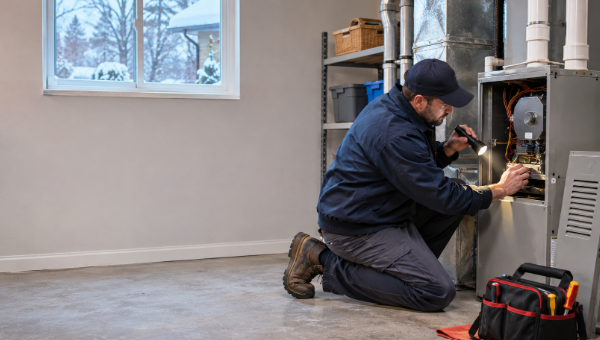
Of course, no one wants to be sitting at home in the cold if their heat goes out in the middle of the night. Many people will jump to the conclusion that the furnace itself must be bad.
However, there are other possibilities which are worth investigating before rushing out to buy a replacement.
Topics Covered:
- Identify if something else is to blame
- What to tell the emergency service provider
- How to remain as safe and warm as possible
- Should you have it repaired or replaced?
- What should happen when having new heating installed
- Things to do once your heating is working again
- Summary
Identify if something else is to blame
As mentioned above, there may be another reason for lack of heat around your property. For example, although your furnace may run on natural gas or oil, there will usually be electrical components involved. So if the whole area was affected by a loss of power, installing a brand new furnace would be pointless!
Assuming you have power and don’t suspect a gas leak, look at the desired temperature set on the thermostat, the on-off switch on the unit, and any relevant fuses. It’s also worth inspecting the air filter. Obviously, further internal inspection should be left to a professional.
Try to establish if the fan blows, if there are any periods of it turning on and off, or if there are any displayed fault codes.
If you find yourself having to repeatedly reset a tripped fuse, there is clearly a problem which should be investigated. Similarly if your system continuously switches off. If other houses around you appear to have lost power, phone the relevant company to ask about expected times of repair.
What to tell the emergency service provider
There’s little point telephoning to have heating installed if you don’t know what the problem may be. So as much as possible describe what has happened, what sort of heating system you have, and confirm if there is electrical power to the property.
Those looking at their options for having a furnace replacement in Manasquan, NJ may wish to enquire how urgently they could come out to inspect and then install an appropriate furnace. An initial visit should establish the cause, but repair or installation timing depends on the diagnosis.
Useful information would therefore include current temperature within the property, rate of decrease, if small children or elderly are present, details and age of current system and any other symptoms such as smells, leaks or noises.
You would also want to know about call-out fees outside business hours, whether they would have appropriate stock to complete an installation that day and any other timescales involved. Try to ensure any quotes given are as accurate as possible. Anyone depending on electrical appliances for medical reasons will of course need to take action to ensure short-term welfare.
How to remain as safe and warm as possible
Obviously, you will want to try to raise the temperature around you, but be careful not to create other hazards. Obvious ones to avoid include cooking range or hobs, barbeque and other portable gas burners. Any generator should of course be well away from the house, recommended minimum 20 feet away.
Use any other electrical heaters according to their manufacturer’s recommendations, i.e. keep away from combustible material (minimum 3 feet), directly plugged into a socket and switched off if you leave or go to bed.
CO is particularly insidious as it can’t be detected by smell or sight. Ensure you have detectors fitted and functioning correctly. All occupants should leave the house if one activates, telephoning 911. Similar action is prudent if anyone suspects they may have been exposed, e.g. feeling sleepy or unwell.
If you smell gas, leave the house at once, switching nothing on or off, and phone 911 and your supplier from outside. Do not rely on this being dealt with by your heating engineer.
Reduce other areas of heat loss, such as closing doors to unoccupied areas and drawing blinds. Monitor the internal temperature of the property more frequently if there are babies and the elderly. At some stage it may be preferable for all to relocate to another warmer location.
Take precautions to prevent freezing of any pipes, for example leaving cupboards open. In severe frost it may be advisable to take other action suggested by authorities.
Should you have it repaired or replaced?
Clearly a variety of faults could result in no heat being produced, many of which may be remedied relatively easily and cheaply. It will of course be up to a suitably qualified engineer to investigate.
Clearly there will be instances of repeated breakdowns, several failed components, high costs, and so on, where it may be preferable and economical to install a newer, more efficient model.
However just because a system may be quite old doesn’t necessarily dictate that it should be replaced, hence it’s worthwhile querying the exact nature of the breakdown, prospects with a repair, length of time to source parts to complete a repair, and so on.
Ideally obtain separate costs to effect any repairs versus a new supply and installation, detailing all relevant work required such as ducting. Naturally if any dangerous aspect to the current system is discovered, this should remain switched off pending engineer’s recommendation.
As always, also consider levels of insulation and ducting around the property, which may well need remedial work.
What should happen when having new heating installed
It would obviously be advantageous to complete works as soon as practicable, but it is important to ensure an adequately sized system is correctly installed.
Ideally the size of appliance should be calculated to meet requirements based on many variables around the house, level of insulation, dimensions, glazing, existing ducting and climatic conditions, to name but a few. An appliance too large can cause frequent switching on and off, whereas a smaller one may be inadequate.
Clearly, the available fuels to run the system will play a part in this decision. Currently around 50% of homes nationwide are heated primarily by natural gas or LP, according to the US EIA. However this will obviously vary considerably for individual properties.
Details about the proposed system, such as input rating, efficiency and type of flue, would all be useful information to receive, together with any requirements relating to air supply and extraction, controls, alterations to ducting, building regulations and disposal.
On completion the whole system should be tested, including all failsafes, and airflows checked. The customer should be shown the operation of the controls and replacement of filters, and be satisfied that adequate temperatures can be achieved throughout, particularly any problem areas previously experienced. Details of appliances and any warranties should be retained.
Naturally if there continues to be no electrical supply to the property this could hinder operation of any new heating system, so suitable alternative arrangements should be considered in the interim.
Things to do once your heating is working again
Arrange a service before next winter. Enquire of any points to be vigilant about during its use, and any maintenance such as replacing filters or clearing obstructions.
Obviously it helps to have the relevant contact details for future breakdowns, plus details of system, size of filters and past works carried out.
Ensure all smoke detectors are in good order, along with any CO detectors. Stock up on torches, blankets, mobile phones, and decide an alternative location to relocate to if necessary.
If certain areas of the house tend to be colder and or if fuel consumption seems high, this may indicate problems with the fabric or ducting as opposed to the heating appliance itself.
Summary
Obviously you’ll want to act promptly to resolve any lack of heating in cold weather, but first ascertain whether this may be due to other causes, such as a general power failure. Ensure those living there are as comfortable and safe as possible and await a suitable engineer to advise on any repairs needed or new installation.
Ideally you want to ensure a satisfactory level of heat can be reliably achieved going forward!