How Extending a Jib Crane Trades Reach for Capacity on a Forklift Carriage
Reach is borrowed, not added
In Canadian fabrication and service shops, one forklift usually has to serve the yard, the dock and the repair bay. It lifts well and reaches poorly: capacity lives close to the carriage, so anything that has to be placed over an obstacle or slung on a chain becomes awkward. A forklift jib crane converts lifting height into horizontal reach, and the trade it makes is worth understanding before the first load leaves the ground.
Every foot of extension costs rated capacity
Ratings on a jib crane fall as the boom extends, and the reason is leverage rather than the strength of the steel. Weight held twice as far from the carriage applies roughly twice the turning effort about the front axle, so the truck resists half as much of it. That is why a jib is published as a table of capacities, one for each extension, instead of a single headline number.
A hanging load is a pendulum before it is a weight
Once a load leaves the ground on a chain it can swing, and a swinging load moves the combined center of mass around while the truck is trying to stand still. The longer the chain, the slower and heavier that swing becomes, in the same way a long pendulum takes its time.
This is what makes travel speed the controlling factor with a jib fitted. Starting gently, stopping gently and keeping the load low enough to steady by hand does more for safety than the rating plate does, because the plate assumes a load that is hanging still.
Fixed, telescoping and pivoting are three different tools
What moves on the attachment sets the work it suits:
- Fixed boom: one reach, stiffest and simplest
- Telescoping boom: reach adjusts, rated capacity falls
- Pivoting head: swings load without turning the truck
A pivoting head earns its keep indoors, where there is rarely room to swing the whole truck around to set a load down. A telescoping forklift boom is the better choice when the same attachment has to reach into a trailer one day and lift close and heavy the next.
See also: Business Acquisition Financing Canada: Funding a Successful Business Purchase
Where a jib earns its place in a small shop
For a shop that lifts irregular loads a few times a week, a forklift crane attachment avoids buying and housing an overhead crane that would stand unused most of the year. The limits are real enough: reach is modest, the load swings, and the truck has to be able to drive to the work.
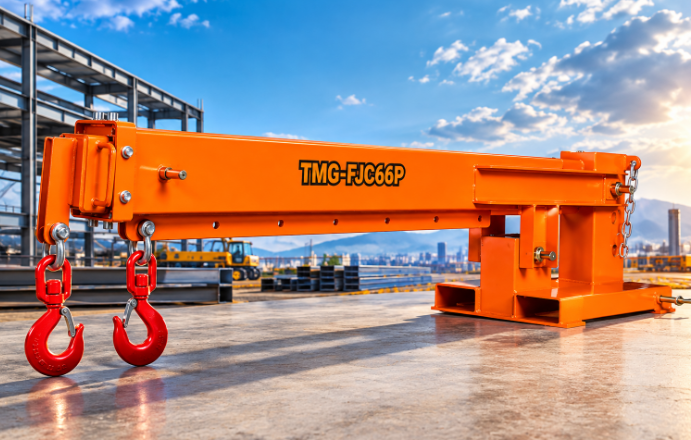
Three things decide whether one will suit a given yard: the capacity the truck keeps at the extension actually needed, whether the ground is flat enough to carry a swinging load, and how the attachment locks to the forks. The jib crane TMG Industrial sells is rated to 6,600 pounds across a boom of thirty to one hundred and thirty-eight inches, which makes the far end of that table the figure to read rather than the headline capacity.