How to Self-Publish a Book: Create, Print & Sell
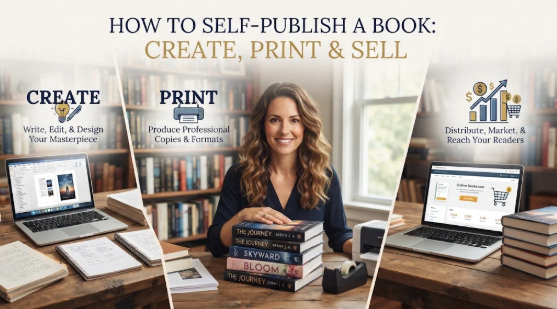
Self-publishing enables writers to be able to manage how their book is written, published, printed, and marketed. The writer may choose to be involved in the entire process or hire individuals to perform specific tasks like editing, proofreading, formatting, design of the cover page, printing, marketing, and distribution. This process ensures that the writer avoids any errors that may happen when writing a book.
What Should You Do Before Publishing a Book?
The first thing that needs to be done is ensuring that the manuscript is ready for publication and there are no problems with its contents. It is necessary to check it for structure, clarity, grammar, consistency, and accuracy of information prior to the preparation of files for publication.
It is also important to determine the target readership and study the literature that is similar to your own book. The knowledge of the target audience can help you choose the right title, cover design, description, format, price, and marketing campaign.
How Should You Edit and Format Your Book?
Professional editing and formatting can make a significant difference to the reading experience. Once the manuscript has been edited, it needs to be prepared separately for each publishing format.
Print books require attention to trim size, margins, fonts, page numbers, chapter layouts, and spacing. Ebooks require responsive formatting so that text displays correctly across different screens and reading devices. Kindle editions should also be checked using appropriate preview tools before publication.
The cover is another important part of the preparation process. It should suit the book’s genre and audience while remaining clear and readable when displayed as a small thumbnail on an online bookstore.
See also: Building a Mental Wellness Plan for Illinois Life
Which Book Format Should You Choose?
These include ebooks, paperbacks, hardcovers, and audiobooks. All of these formats may be used depending on the audience, budget, genre, and marketing strategy.
| Format | Main strength | Important factor |
| Ebook | Low cost of creation | Needs correct format for digital distribution |
| Paperback | Inexpensive printed version | Necessitates interior and cover files in print form |
| Hardcover | High quality of presentation | Is more expensive to create |
| Audiobook | Good for listening | Necessitates recording process |
Multiple formats will allow making a book available to various groups of readers. Nonetheless, each version needs to be reviewed separately.
How Can You Publish a Book Through Amazon KDP?
Amazon Kindle Direct Publishing (KDP) allows authors to publish ebooks and print books through Amazon. The process generally involves preparing the manuscript and cover, entering book details, selecting publishing options, setting the price, and reviewing the final product before publication.
For Kindle books, authors should check the ebook through the available preview tools to identify layout or formatting problems. Print editions should also be reviewed carefully for page layout, margins, cover dimensions, and page count. A physical proof can be particularly useful for identifying problems that are difficult to notice on a computer screen.
Book metadata should also be accurate. Titles, descriptions, categories, and keywords should describe the actual content of the book rather than being used to mislead readers.
How Can You Arrange Printing and Distribution?
Authors who want physical books can use print-on-demand or traditional bulk printing. Print-on-demand allows copies to be produced when customers place orders, reducing the need for large quantities of inventory.
Bulk printing may be useful when an author needs many copies for book events, direct sales, bookstores, or special editions. However, it usually requires more upfront spending and creates additional responsibilities for storage and order fulfillment.
Distribution should be planned before publication. Authors should decide whether they want to sell through online retailers, their own website, independent bookstores, events, or several channels.
How Can You Choose the Right Publishing Support?
Authors who prefer professional assistance can work with a British Publishing UK provider for services such as editing, formatting, cover preparation, publishing support, or distribution. The exact services offered can vary, so authors should check what is included before agreeing to a package.
When comparing providers, consider their experience, service scope, pricing structure, communication process, revision policy, and ownership terms. A clear agreement should explain what work will be completed and what files or rights remain with the author.
How Should You Set the Book’s Price?
Book pricing should take production costs, format, retailer terms, book length, genre expectations, and the intended audience into account. Ebook pricing may differ considerably from paperback or hardcover pricing because production and distribution costs can vary between formats.
Researching comparable books can provide useful context. However, authors should not simply copy another book’s price. Their own costs, publishing objectives, audience, and sales channels should also be considered.
What Should You Check Before Launching?
Before releasing the book, create a final checklist covering the manuscript, cover, formatting, metadata, ISBN requirements, pricing, distribution, and retailer listings. Every edition should be checked separately because an ebook that displays correctly does not automatically mean that the paperback file is ready.
Authors should also prepare basic promotional materials before launch. These may include an author website, email announcements, social media posts, advance reader outreach, and other relevant promotional activities.
Authors choosing self publishing UK should also understand that publishing the book is only one part of the process. Building awareness, reaching the intended readership, and maintaining accurate retailer information can continue after the initial launch.
www.britishselfpublishing.co.uk
How Does Self-Publishing Compare With Traditional Publishing?
While both publishing models can lead to professional-quality books, there is a different allocation of duties in each case.
| Factor | Self-publishing | Traditional publishing |
| Creative control | Higher degree of control | Control shared with publisher |
| Publishing schedule | Under control of the author | Dependent upon publisher’s schedule |
| Upfront work | Author has to do more work | Publisher does most of the work |
| Professional services | Provided by author | Provided by publisher |
| Distribution | Decided and controlled by the author | Done by the publisher |
| Marketing | Usually done by author | Done in cooperation with author |
Depending on what the author wants to achieve, one way may be more suitable than the other.
What Common Self-Publishing Mistakes Should You Avoid?
Some common errors in publishing are releasing books without adequate proofreading, picking an inadequate cover, not following formatting guidelines, pricing the book without researching, and promoting the book before it is finished.
Another common mistake in publishing is that people think all formats need to be produced in the same way. Each format has its own technical guidelines that have to be followed, including ebooks, paperbacks, hardcovers, and audiobooks.
Also, authors have to keep their files, such as manuscript files, cover files, metadata, and publishing records.
Visit us at www.britishselfpublishing.co.uk for professional help with:
editing, formatting, publishing, and book production.
Conclusion
Self-publishing involves much more than just putting a manuscript on a retailer’s website. The author has to format the book, make sure there are appropriate covers for it, decide which formats to use for publication, organize printing or distribution, set up prices, and market the published material. Proper planning during each step will enable you to avoid mistakes. Be it an eBook for Kindle, paperback, hardcover, or audio book, each of them needs to be prepared properly.