How QCW Fiber Laser Welding Supports Precision Manufacturing
Precision manufacturing depends on processes that can produce consistent results while limiting unnecessary material damage. In industries such as tooling, automotive production, electronics, and mold manufacturing, even a small defect can affect the performance or appearance of a finished component.
Laser welding has become an important option for applications that require controlled heat input and accurate joining. Within this category, quasi-continuous-wave technology offers characteristics that may be useful for certain precision welding and repair tasks.
Understanding how the technology works can help manufacturers decide whether it fits their production requirements.
Understanding QCW Laser Technology
Quasi-continuous-wave, commonly abbreviated as QCW, describes a laser operating mode that delivers energy in pulses or controlled bursts rather than relying only on a continuous output. The exact pulse characteristics depend on the equipment’s design and settings.
This approach can provide high peak power during short intervals while allowing the overall energy delivery to be controlled. In suitable applications, that combination may help operators weld small features or repair localized defects without applying unnecessary heat to the surrounding material.
The benefits depend on the workpiece, material thickness, joint design, surface condition, and selected process parameters. QCW technology should therefore be evaluated through practical testing rather than assumed to suit every welding task.
Why Heat Control Matters
Welding creates a localized thermal cycle. If too much heat enters a component, it may cause distortion, discoloration, changes in material properties, or damage to nearby features.
These concerns are especially important when repairing precision tools and molds. A mold may contain detailed cavities, narrow edges, or surfaces that must retain their original dimensions. Excessive heat can increase the amount of finishing work required after welding.
A properly configured laser process can concentrate energy within a relatively small area. Operators still need to control pulse settings, focus, travel speed, and material preparation to achieve the desired result.
Applications in Mold Repair
Molds and dies are exposed to repeated mechanical and thermal stresses. Over time, edges, cavities, and other working surfaces may develop wear or localized damage.
Depending on the material and defect, laser welding may be used to restore a small area before machining, grinding, polishing, or other finishing operations. The objective is to repair the component while preserving as much of its original geometry as possible.
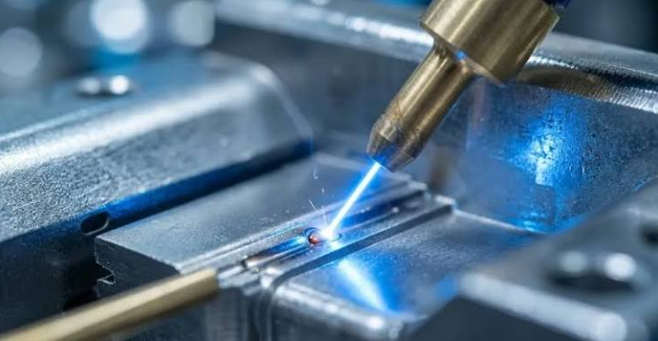
A qcw laser welder is one type of equipment manufacturers can investigate when comparing solutions for mold repair. Before choosing a machine, they should review its output specifications, pulse settings, workpiece compatibility, operating envelope, and support requirements.
The repair procedure should also account for the mold’s material composition and heat-treatment history. Not every defect can be corrected safely through welding, and some components may require a different repair method or replacement.
Preparing Materials for Welding
Preparation is essential for consistent results. Oil, oxide, dust, and other contaminants can interfere with welding and contribute to defects. The workpiece should be cleaned according to the process requirements before repair begins.
Operators should examine the damaged area and determine whether additional preparation is needed. Cracks, deep wear, and complex damage may require more extensive assessment than a simple surface defect.
Filler material, where used, must be compatible with the base material and the required finished properties. The selected welding parameters should be validated on representative material before they are applied to a critical component.
Establishing Reliable Process Parameters
Laser welding involves several interacting variables, including pulse energy, pulse duration, repetition rate, focus position, and movement speed. Their effects depend on the equipment and material.
A controlled trial can help identify a suitable starting point. The operator should evaluate penetration, bead shape, visible defects, and the condition of the surrounding material.
Once the process has been validated, documented settings and inspection criteria help improve repeatability. Changes in material, thickness, or joint geometry may require further testing.
Operator Training and Workshop Safety
Laser equipment requires suitable training and safety procedures. The work area should follow the manufacturer’s requirements for laser classification, protective enclosures, access control, personal protective equipment, and fume management.
Reflective materials and exposed laser radiation can create hazards if the system is used incorrectly. The workshop should also manage hot components, electrical equipment, and any fumes generated by the welding process.
Routine inspections and preventive maintenance help keep the equipment in suitable operating condition. Operators should know how to recognize faults and when to stop work.
Evaluating Productivity and Quality
Manufacturers should assess more than the initial welding speed when comparing equipment. Relevant factors include setup time, repair accuracy, finishing requirements, consumables, operator training, maintenance, and the percentage of components successfully restored.
A process that produces a clean repair but requires extensive finishing may offer a different productivity outcome from one that produces a suitable result with less post-processing.
Trial repairs on representative components can provide useful evidence before a business invests in new equipment.
Conclusion
QCW fiber laser welding can be useful for precision manufacturing and selected mold-repair applications where controlled energy delivery is important. Results depend on suitable equipment, material compatibility, validated process settings, and trained operators.
By evaluating the technology through representative trials and a complete cost assessment, manufacturers can determine whether it supports their quality and production goals.