Drug Rehabilitation in Mumbai: Three People Can Say “I Use Drugs” and Need Completely Different Treatment
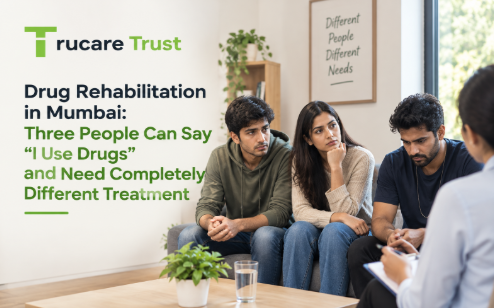
Consider three admissions.
The first person uses heroin every day and becomes physically unwell when several hours pass without it.
The second uses cocaine mainly on weekends. Monday is spent recovering, but by Wednesday they appear normal enough that the family wonders whether treatment is really necessary.
The third smokes cannabis every night and says it is impossible to sleep without it.
All three might describe themselves as having a drug problem.
That is where the similarity largely ends.
The 2019 AIIMS-NDDTC national survey estimated approximately 2.26 crore opioid users and 3.1 crore cannabis users in India. Smaller populations reported other substances, including cocaine and amphetamine-type stimulants.
A drug rehab in Mumbai should therefore identify the substance and pattern before applying a treatment plan.
The heroin case
Opioids deserve separate attention because dependence, withdrawal and overdose risk create a particular clinical picture.
The national survey estimated around 77 lakh people in India needed help for opioid-use problems.
Not all opioid users needed treatment.
That distinction between use and disorder matters.
For someone with opioid-use disorder, medicines such as methadone or buprenorphine can form part of evidence-based treatment. NIDA’s review of the evidence reports that both can reduce illicit opioid use when appropriately administered.
This immediately makes opioid treatment different from cocaine treatment.
The family’s idea that “all addiction should be treated by complete abstinence from day one” may not reflect the treatment plan a qualified clinician recommends.
See also: Building a Mental Wellness Plan for Illinois Life
The weekend cocaine case
Cocaine creates a different cycle.
The person may function reasonably well much of the week.
Friday arrives.
Alcohol begins.
The same group appears.
Cocaine is available.
Use continues late into the night.
The person spends Saturday anxious, exhausted or low, promises this was the final time and is back at work by Monday.
That cycle can continue long enough for the person to argue convincingly that there is no serious problem.
Current treatment evidence for cocaine-use disorder relies heavily on behavioural approaches. NIDA discusses contingency management and cognitive behavioural therapy among the approaches with evidence.
There is no equivalent of methadone treatment for cocaine addiction.
The rehab plan should therefore spend serious time on the sequence surrounding use.
If alcohol, certain friends and weekend access repeatedly occur before cocaine, those are not background details.
They are part of the treatment problem.
The cannabis-and-sleep case
The third person is different again.
No dramatic binge.
No overdose.
No Monday crash.
Cannabis simply became part of every evening.
After years of this pattern, the person stops and finds that sleep is poor, irritability increases and appetite changes.
Cannabis withdrawal is recognised, although its clinical profile is different from alcohol or opioid withdrawal.
NIDA describes behavioural approaches including cognitive behavioural therapy, contingency management and motivational enhancement therapy as treatments that have shown promise for cannabis-use disorder.
There is currently no FDA-approved medication specifically for cannabis-use disorder.
If the person’s entire reason for returning to cannabis is “I cannot sleep without it”, treatment needs to address sleep rather than arguing endlessly about cannabis.
One rehabilitation building cannot make the biology identical
Residential treatment can still provide useful things across all three cases.
Structure.
Distance from access.
Time.
Counselling.
A chance for families to stop reacting crisis by crisis.
But the medical and psychological plan should differ.
Someone with heroin dependence may need opioid-specific medical care.
The cocaine user may require detailed work around social situations, alcohol and stimulant craving.
The cannabis user may need a substantial reset of sleep, routine and the social environment surrounding nightly use.
A drug rehabilitation centre Mumbai should be able to explain these differences rather than describing one fixed programme as equally appropriate for every substance.
Families do not need to identify the diagnosis themselves.
They do need to provide good information.
What has actually been seen?
How is the drug taken?
When was it last used?
What happens when the person stops?
Has there been an overdose?
How has sleep changed?
What other substances are involved?
Are prescribed medicines being taken?
These details often tell treatment professionals more than a long argument about whether somebody is “really addicted”.
“Drug addiction” is a useful umbrella phrase.
Treatment happens underneath the umbrella, where the differences matter.